
How Much Should I Spend on Facebook Ads to Get Results?Your blog post
There's no magic number for Facebook Ads budget, but there is a smarter way to think about it. Here's the tiered approach I use with lead gen clients to get reliable results.
Prajwal Aryal
6/5/20264 min read
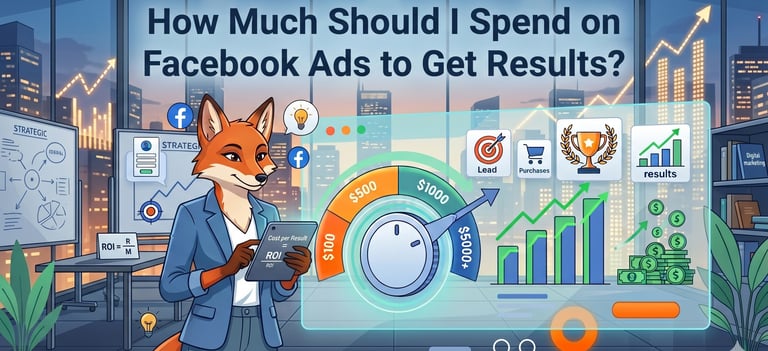
The most honest answer to this question is something no one wants to hear: it depends. But before you close this tab, the follow-up is more useful. It depends on something you can actually figure out, not something you need to guess at.
I get asked about Facebook Ads budgets all the time, and almost always the question comes with one of two assumptions: Either the client thinks they can run a meaningful test on $5 a day (they can’t), or they’ve been burning through a few hundred dollars a month, seeing nothing stick, and decided that Facebook Ads just don’t work for their business. For the most part, the problem was not the platform. It was the budget plan.
So let's get this straight properly.
Why do your early results not tell you much?
The initial metrics you receive from a Meta Ads campaign do not provide a definitive gauge of how this ad will perform. When you first run a campaign, Meta's algorithm is in a 'learning' mode, meaning that it's testing different audience groups and behaviours to determine who is most likely to take the desired action it's asking of them (completing a form, calling you, etc.). This testing process is often referred to as the 'learning' phase by Meta and usually requires around 50 successful actions before it can be said to have completed the learning phase and moved on to optimisation.
This information is very informative when determining how much budget to allocate to your ads because if you are not spending enough to complete your 50 successful actions within a 1-2 week experiment period, then the algorithm has not had the opportunity to gather enough data to successfully optimise itself. Therefore, your cost per lead remains high, your results are inconsistent, and you will eventually terminate your campaign before it has had the opportunity to demonstrate its true potential. It is similar to judging a restaurant solely by the quality of the bread served to you.
The cost per lead you experience in week one of your campaign will most likely not be the actual cost per lead experienced in weeks two through five, but rather the cost per lead experienced while Meta is still learning about your audience and how they will respond to your ads.
The learning phase is also why I'm sceptical of anyone who tells you Facebook Ads didn't work after a two-week, low-budget test. That's not a test. That's a taster.
Understanding this changes how you should think about the budget entirely. You're not just buying ad placements. You're buying data, and the algorithm needs enough of it to do its job. Underfund that process, and you're not saving money; you're just guaranteeing slow, unreliable results.
So what should you actually spend?
Rather than throwing out a number, I use a tiered approach with clients. It starts with one question: what's a lead actually worth to you?
If you know your close rate and your average client value, you can work out the maximum you can afford to pay for a lead and still have the campaign make sense. Say your average client is worth $3,000, and you close one in five leads. That means each lead is worth $600 in potential revenue. You've got a lot of room to work with. If your average client is worth $500 and you close one in ten, the maths looks very different.
From there, I start with a test budget designed to generate enough data to learn from, without betting the house before you know what works. For most service-based businesses in Australia, that means a minimum of around $1,500 to $2,000 per month to run a proper test. Below that, you're likely to exit the learning phase with inconclusive data or not exit it at all.
The test phase is not about results. It's about signals. Which creative is resonating? Which audience is responding? What's the early cost per lead telling us? Once you have two to four weeks of real data, you have something to work with. You scale what's working, cut what isn't, and the budget conversation shifts from "How much should I spend?" to "How much do I want to grow?"
One thing worth saying clearly: scaling doesn't mean doubling your budget overnight and expecting double the leads. Meta's algorithm responds better to gradual increases, somewhere in the range of 20 to 30 per cent at a time, with room to stabilise between changes. Patience isn't a soft skill here. It's a genuine performance lever.
Budget alone won't save a bad offer or a poorly structured campaign. I've seen businesses spend $10,000 a month and get nothing useful because the targeting was too narrow, the creative was tired, or the landing page was doing the leads no favours. Spend matters, but it's not the only variable. If your fundamentals are off, more money just means faster confirmation that something's broken.
The businesses that get consistent, scalable results from Meta Ads are usually the ones that treat it as a system, not a slot machine. Start with a budget that gives the algorithm something to work with, read the data honestly, and build from there. It's less exciting than a hot take, but it's how it actually works.
Contact
Let's chat about your ad goals.
Call
© 2026. All rights reserved.